
The Anatomy of a Stucco Wall: Why the Moisture Barrier Matters More Than the Stucco
When people picture a stucco wall, they picture the part they can see: the texture, the color, the finish. But the layer that decides whether your building stays dry is one you’ll never see, costs a fraction of the job, and gets less attention than any other part of the wall — right up until it fails.
I’ve spent 41 years in the waterproofing and plaster trades, and the single most useful thing I can teach a property owner is how their wall is actually built. Once you understand the layers, every stucco problem you’ll ever encounter makes sense. So let’s take the wall apart, from the inside out.
The framing and sheathing: what everything else protects
At the core is the structure — wood studs and sheathing on most Bay Area buildings. Wood is strong, but it has one non-negotiable requirement: it must stay dry, or at least be able to dry out when it gets damp. Every layer outside of it exists to honor that requirement. When you hear “dry rot” or “water damage,” this is the layer paying the bill.
The moisture barrier: the wall’s actual raincoat
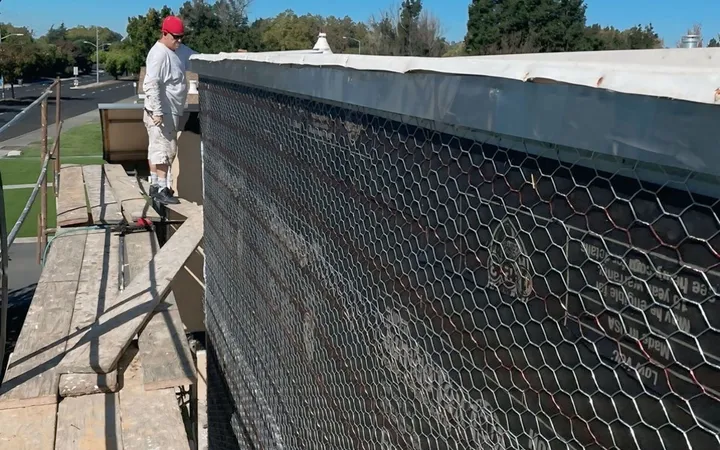
Directly over the sheathing goes the water-resistive barrier — traditionally two layers of building paper, or modern barrier membranes on newer assemblies. Each course laps over the one below, shingle-fashion, so water touching the barrier is directed down and out, never inward.
Here is the fact that reorganizes everything else: stucco is not waterproof, and it isn’t supposed to be. Stucco is what the trade calls a reservoir cladding — it sheds most rain, absorbs some, and releases it as vapor afterward. The barrier behind it is the layer that actually keeps water out of the structure. A sound barrier is why one stucco wall protects a building for seventy years while an identical-looking wall rots in ten. It’s also why most of the damage we repair traces to a barrier or flashing failure, not the stucco coat itself.
Flashing: where the barrier would otherwise have holes
A barrier is only as good as its interruptions. Every window, door, vent, hose bib, deck ledger, and roof-wall intersection cuts a hole through the raincoat — and flashing is the metalwork that closes each hole and hands water back to the outside. Head flashings over openings, kick-out flashings where roof edges die into walls, ledger flashings at decks: small, unglamorous details that decide outcomes. When we trace a chronic leak, the trail ends at a missing or mis-lapped flashing more often than anywhere else.
The lath: the skeleton the plaster grips
Over the barrier goes metal lath — the mesh that gives wet plaster something to bite into, fastened through to the framing. Good lath work is flat, taut, properly furred, and correctly terminated at openings and edges. Bad lath work telegraphs through the finished wall as cracking and hollow spots years later, when it’s no longer visible to blame.
The three coats: scratch, brown, and finish
Now the plaster, applied in three lifts. The scratch coat is pressed into the lath and raked horizontally so the next coat can grip it. The brown coat builds the wall’s thickness and is floated straight and true — the flatness of your finished wall is won or lost here. The finish coat carries the color and texture, and it’s the only layer anyone ever compliments. Each coat needs proper curing time; the patience between coats is invisible in the finished wall but present in how it performs for decades.
The weep screed: the drain at the bottom
At the base of the wall sits the most underappreciated piece of metal on the building: the weep screed. Any water that gets behind the stucco — and over decades, some will — runs down the face of the barrier and exits here. That’s the system working. Which is why burying this edge under soil, bark, pavers, or a new patio slab is one of the most common self-inflicted stucco wounds we see: block the drain, and the wall wicks water upward instead of weeping it out.
Why the barrier matters more than the stucco
Pull all of that together and the hierarchy becomes obvious. Stucco coats can crack and be repaired in place. Finish coats can be redone. Texture can be matched. But the barrier is structural to the system — when it fails, everything in front of it becomes a delivery route for water, and correcting it means opening the wall. A mediocre finish over a sound barrier is a cosmetic problem. A beautiful finish over a failed barrier is a slow demolition.
That’s why, when we build new stucco assemblies, we install barrier, flashing, lath, and plaster as one accountable scope — and why, when we repair, we insist on knowing the condition of the layers we can’t see before quoting the ones we can.
If you’re planning stucco work — or trying to understand why a wall is misbehaving — call Fogg Construction at 415-827-0782 or reach us through our contact page. We’ll tell you what’s going on behind your stucco, not just on it.