
Venetian Plaster: What Bay Area Homeowners Should Know Before They Commit
Venetian plaster has a way of ending up on a homeowner’s wish list long before they know what it actually is. They’ve seen it in a hotel lobby, a wine-country tasting room, or a designer’s portfolio — a wall with depth, a surface that seems to shift as the light moves across it — and paint suddenly looks flat by comparison.
It’s a finish worth wanting. It’s also a finish that punishes shortcuts more than almost anything else in the plaster trade. Before you commit a room — or a whole house — to it, here’s what four decades on the trowel has taught me you should know.
What Venetian plaster actually is
Venetian plaster is a lime-based plaster (modern versions are often polymer-enhanced) applied in multiple thin layers with a steel trowel, then burnished — compressed and polished — to its final finish. The color isn’t painted on top; it’s mixed integrally into the plaster itself. The depth you see comes from the layered application: each pass leaves subtle variation that the burnishing locks into the surface.
That construction is why no paint technique truly imitates it. Faux finishes put a picture of depth on a wall. Venetian plaster builds the depth into the wall.
It’s also genuinely durable. Properly applied and burnished plaster is a hard, long-lived surface that resists scuffing better than most painted walls, ages gracefully, and — unlike paint — can be repaired and re-burnished by a skilled plasterer rather than redone wholesale.
Where it shines in a Bay Area home
The finish earns its keep in spaces where light and surfaces do the talking: living rooms, dining rooms, entries, stairwells, primary suites, and feature walls that anchor a room. In commercial settings, lobbies, restaurants, and retail spaces use it for the same reason — it reads as quality from across the room and stands up to use.
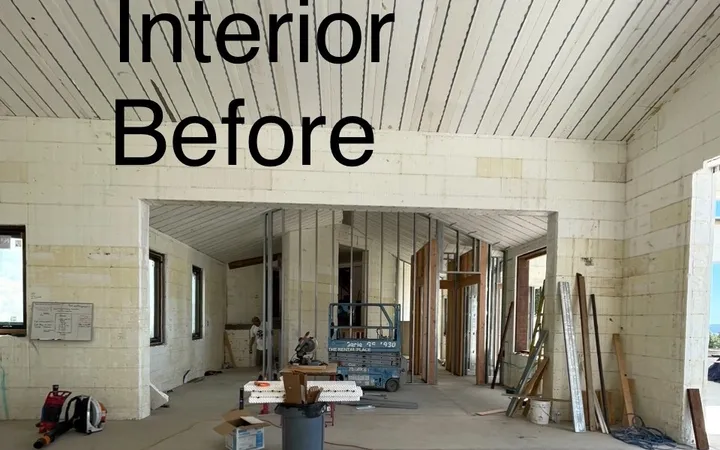
Ceilings deserve a special mention. A plastered ceiling is spectacular precisely because it’s difficult — raking light across a ceiling exposes every trowel mark and substrate flaw, with nowhere to hide. At the Skyfarm residence in Santa Rosa, we applied smooth, colored Venetian plaster across walls and ceilings throughout, paired with new exterior stucco for a unified design inside and out. Ceilings are where you find out whether your plasterer does this work regularly or occasionally.
One practical note for Bay Area buildings: Venetian plaster goes happily over standard drywall as well as plaster substrates, so it suits remodels and new construction alike. But the substrate must be prepared correctly — properly primed, flat, and sound — because the finish telegraphs every shortcut underneath it.
Why the applicator matters more than the material
Here’s the part most homeowners don’t hear until it’s too late: with Venetian plaster, you are not really buying a material. You’re buying hands.
The plaster goes on in thin coats, each one troweled by feel. Pressure, angle, timing between coats, the rhythm of the burnish — none of it can be specified on paper, and all of it shows in the finished wall. Done well, the surface is seamless and alive. Done poorly, every lap mark, stop-start line, and uneven burnish is permanent, in a material that costs real money to remove and redo. It is, bluntly, unforgiving of inexperience.
So qualify the person, not the brochure. Reasonable questions to ask anyone bidding the work:
- How much of this finish do you personally apply in a year? Venetian plaster is a practiced skill, not an occasional add-on.
- Have you done ceilings? If yes, ask to see them.
- Who exactly will hold the trowel on my job? The estimator’s portfolio means little if someone else applies the finish.
- How do you handle samples? The right answer involves physical sample boards, not a fan deck.
Interior Venetian plaster is one of Fogg Construction’s four core specialties — not a sideline we quote when asked — and that distinction is exactly what you should be probing for with any contractor.
Settle these things before anyone opens a bucket
Color and sheen together. They interact — the same pigment reads differently at different polish levels. Approve a physical sample board that shows your color at your sheen, in your light, before the first coat goes on the wall. The wall you approve should be the wall you get.
Expect variation — it’s the point. Venetian plaster has movement and subtle tonal shifts within the surface. If you want perfectly uniform color with zero variation, you want paint, and an honest contractor will tell you so.
Plan the room around the wet trade. Plaster is applied in sequence with drying time between coats. Build it into the schedule rather than squeezing it between the painters and move-in day.
Venetian plaster is one of the few finishes that genuinely improves a home rather than just decorating it — when the hands applying it have done it a thousand times. Take the time to find those hands.
Considering Venetian plaster for a room, a remodel, or a new build anywhere in the Bay Area? Call Fogg Construction at 415-827-0782 or reach us through our contact page — we’ll talk through your space, develop samples, and show you exactly what your walls can be.