
How Wind-Driven Rain Gets Behind San Francisco Stucco — and How to Stop It
Rain in most places falls down. Rain in San Francisco travels sideways. When a winter storm pushes through the Golden Gate, water hits stucco walls under wind pressure — and pressurized water doesn’t behave like the gentle vertical rain a wall sheds easily. It climbs. It gets driven uphill into laps and joints, forced through hairline cracks, and pumped into any penetration that was sealed with caulk and good intentions.
Add the fog belt, where exterior walls can stay damp for weeks without a drop of rain, and you have the most demanding stucco environment I’ve worked in over 41 years in the waterproofing trade. Here’s what’s actually happening to San Francisco walls — and what keeps the water out.
Why San Francisco walls get wetter than the rainfall says they should
Three things gang up on a stucco building here.
Wind pressure defeats gravity. Flashing and building paper work on a simple principle: each layer laps over the one below, so water moving downward stays on the outside. Wind-driven rain moves sideways and upward. A lap that’s adequate for vertical rain can be short enough for pressurized water to ride up and over. Details that pass in Sacramento fail on a west-facing wall in the Sunset.
The walls never fully dry. Stucco is a reservoir cladding — it absorbs some water in every storm and releases it as vapor afterward. That works when there are dry spells to release into. In the fog belt, marine air keeps the wall damp, so each storm starts from a wetter baseline. Moisture that would evaporate harmlessly elsewhere has time to find its way inward.
The housing stock is old. Much of San Francisco’s stucco sits over wood framing, built when building paper was a single thin layer and flashing practice was whatever the plasterer did that decade. The original assemblies have been protecting these buildings for generations — but where they’ve been cut into for windows, vents, electrical, and cable over the years, every un-repaired cut is a door.
The three doors water actually uses
When we open up a leaking San Francisco wall, the entry point is almost always one of three things.
Penetrations sealed with caulk alone. Hose bibs, light fixtures, dryer vents, conduit, cable penetrations — every one is a hole through the water barrier. Caulk at the surface is a maintenance item with a lifespan of a few years, not a waterproofing detail. Wind pressure finds the gap the day the caulk lets go. Done right, a penetration is flashed and tied into the barrier behind the stucco, so the surface seal is the second line of defense rather than the only one.
Flashing that’s missing, short, or backwards. Head flashings over windows and doors, kick-out flashings where rooflines die into walls, ledger flashings at decks. On older buildings these are routinely absent; on newer ones they’re often present but lapped wrong, with the barrier tucked behind the flashing instead of over it. Wind-driven rain exploits both. Correcting these details is the heart of our flashing and drainage work — small metal, big consequences.
Hairline cracks over a tired barrier. Cracks in the stucco itself admit surprisingly little water if the barrier behind them is sound — that’s the system working as designed. But when decades of moisture have degraded the building paper behind a cracked area, the wall’s second line of defense is gone, and every crack becomes a direct path to the sheathing. This is why two identical-looking cracked walls can be in completely different condition underneath.
What actually stops wind-driven rain
Not paint, and not another bead of caulk. The fixes that hold are the ones that restore the wall to a layered system:
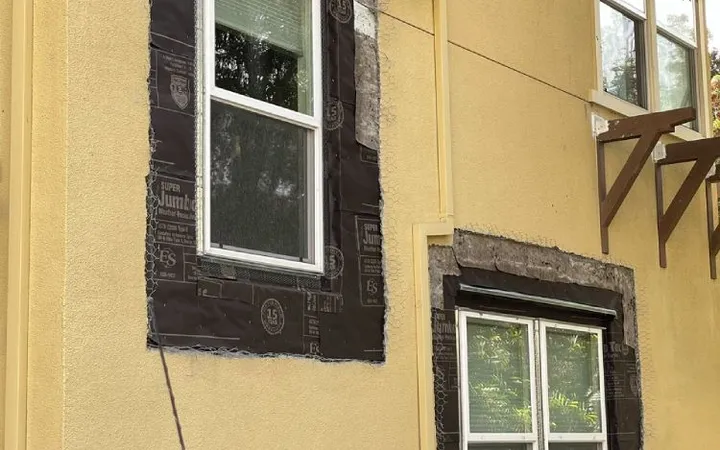
- A continuous, properly lapped moisture barrier behind the stucco, with generous laps that account for wind-driven exposure. This is the wall’s real raincoat — the stucco is the overcoat. Our waterproofing and moisture barrier work treats barrier, flashing, and stucco as one assembly, because that’s how water sees them.
- Flashing at every interruption — heads, sills, penetrations, roof-wall intersections — integrated into the barrier in shingle fashion, sized for sideways rain.
- Watertight window perimeters. Windows interrupt the barrier more than anything else on a wall, and they deserve their own discipline; our window waterproofing work rebuilds the flashing and barrier around the frame, not just the visible sealant joint.
- Crack repair that includes the barrier. Where cracking overlies a failed barrier, the lasting repair opens the stucco locally, rebuilds the paper and flashing, and patches the finish to match.
The pattern in all of this: surface treatments fail in San Francisco because the water isn’t attacking the surface — it’s attacking the system. Repair the system and the building goes quiet, even on a February night when the rain is horizontal.
If your San Francisco stucco shows staining after storms, damp interior walls, or leaks that keep returning no matter how often they’re caulked, call Fogg Construction at 415-827-0782 or reach us through our contact page. We’ll find the door the water is using — and close it properly.